


2026
VIRTUAL HORSE SHOW
To participate in this FREE online show, you need to be an EBRA Member. Don't worry, you can be from anywhere in the world and do not have to register horses with us to be part of our community. If you're not a Member, you can quickly join our community by clicking HERE. Again, your horse does not need to be registered with the EBRA to compete.
Registration and Submissions: Registrations are open June 1st, and they will be open until November 2nd at 5 pm EST. While you do not need to submit your video(s) and photo(s) at registration, all videos and photos for the competition must be captured and submitted between June 1st and November 2nd at 5 pm EST. Online Show Party: An EBRA Virtual Horse Show watch party will take place on Saturday, December 5th at 12 pm EST online. 2026 Virtual Horse Show Classes: Halter Class: 5 Photos and 1 video Liberty Class: 1 video Showmanship Class: 1 video Trail Classes (In-hand/Under-saddle or Driving): 1 video Pleasure Riding and Driving Classes: 1 video Log Pulling: 1 video Traditional Raffia Class: 5 Photos Handler Guidance: Each unique handler must complete a registration form. A handler may exhibit more than one horse, but will be required to submit a new registration form per horse. A horse may only compete in one Halter Class, and a handler may only compete in one Showmanship, Trail, Riding, Driving, and Log-Pulling Class. The same horse may be used by multiple handlers competing in the Showmanship, Trail, Riding, Driving, and Log-Pulling Competitions. A new registration form must be completed per handler, even if using the same horse.
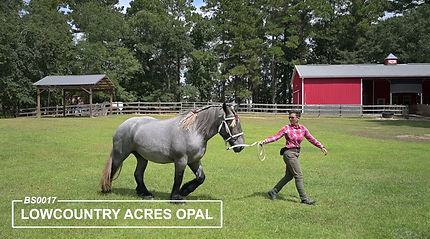
Photo & Video Requirements: When taking photos and video(s) for the virtual show, be sure your horse is clean, with no saddle or harness. For the Halter Class, each exhibitor is required to record a video of themselves performing the posted pattern.
Halter Class
Halter Classes are a conformation-based class where horses are led by a handler "in hand", and are judged strictly on their physical anatomy, structural correctness, and how closely they match the European Brabant standard. Instead of evaluating performance or athletic maneuvers, the judge evaluates the animal's structural "form to function" to determine its suitability as breeding stock or a prime representative of the breed.


HALTER
SHOWMANSHIP
Showmanship Class
Showmanship is a horse show event where the horse is led “in hand,” but the handler is judged entirely on their showmanship skills, ring craftsmanship, and grooming preparation, rather than the horse's physical conformation. The horse serves as a prop to demonstrate the handler's ability to fit, train, and flawlessly maneuver an equine partner through a precise pattern.
Video Requirements: When taking the showman video(s) for the virtual show, be sure your horse is clean, with no saddle or harness. For the Showmanship Class, each exhibitor is required to record a video of themselves performing the posted pattern in one continuous recording.


Video Requirements: When taking the liberty video(s) for the virtual show, be sure your horse is clean, with no saddle or harness. For the Liberty Class, each exhibitor is required to record a video of their untethered, free horse at the walk, trot, and canter, in both directions.
Liberty Class
The Liberty class is where a horse is shown freestyle and unbound in an arena/paddock/pasture, demonstrating freedom and movement. Judges look for freedom of movement, soundness, and willingness to move forward. The maximum time allowed for the liberty competition is 3 minutes to showcase the walk, trot, and canter. Liberty sticks, carrot sticks, and whips (lunge, dressage, carriage, etc.) are permitted to direct and/or guide horse(s), but no contact with the horse is permitted. Any use of any equipment excessively, in an inhumane manner, or in an abusive way will result in a "no score."
LIBERTY
Trail Class
The trail class is an event judged under in-hand, under saddle, ground driven, or hitched and tests a horse’s ability to navigate obstacles commonly encountered on a real-world trail ride or a working ranch. Rather than focusing on speed, the class is judged strictly on safety, manners, willingness, and the technical precision of the horse's footwork. A good trail horse lowers its head, looks directly at the obstacle to judge the distance, and carefully places its feet. Each required obstacle is graded on a scale. The horse must trust the handler's aids and move forward smoothly without hesitation, rearing, or shying away from scary objects.
Video Requirements: When taking the trail class video(s) for the virtual show, each exhibitor is required to record a continuous video of themselves performing the posted pattern. While safety equipment, such as helmets, is not required for adult classes, the EBRA strongly encourages the use of helmets. For those competing in Youth riding/driving categories, helmets are required.
TRAIL


Ground/Hitched Driving Trail Class Pattern
The Driving Trail Class can be performed while hitched to a vehicle or when unhitched and driven on the ground. The class can be performed with a single horse or a team of horses.
In-Hand/Riding Trail Class Pattern
For those opting to compete "under saddle," competitors are not required to use an actual saddle. Exhibitors may use a bareback pad or simply go bareback. Also, riders are permitted to go bitless too.
Log Skidding Class
The log-skidding class requires a horse to safely drag a log through an obstacle course. Horses are required to pull logs through turns, testing their responsiveness and calm demeanor. The driver must skid one 12-foot log through a slalom/serpentine course marked by pylons, cones, or narrow alleys. The course has a 5-minute time limit. The clock starts when the first horse's head crosses the starting line and stops only when the final 2 feet of the log sit squarely on the finish line. Drivers cannot lift or manually adjust the log with their feet or body during the run. No Striking or Whipping: Competitors are barred from whipping, striking, or forcefully jerking the lines. Only verbal commands and light line shakes are permitted. Any team deemed overly excited, aggressive, or a safety hazard to spectators and other horses will be immediately excused from the arena by the judge.


Video Requirements: When taking the log-pulling video, be sure to film one continuous recording throughout the pattern.
LOG SKIDDING
Serpentine Slalom Course:
-
Space 6 markers such as cones or buckets, 20’ apart. Clearly mark the start/end line with a surveyor flag, stake, or similar 10‘ from the first marker. The boundary lines should be 10’ from center and made visible with line marker spray paint, scraped surface or similar for a total of 20‘ working space.
-
Skid a single 12’ log (12-15” in diameter) through the posted pattern consisting of markers placed at intervals in the center of a line. Precision and control of the horse and log is the primary goal, simulating a logging activity.
-
The driver must walk alongside or ride the log, but not both. The driver MAY NOT lift, guide with feet, or manipulate logs in any way with his/her body at any time while on course.
-
Penalties are assessed if the horse or the dragged log touches or disturbs the markers or cones. There is a 5 minute time limit for the driver to complete the course.
-
Time starts when the horse’s head crosses the starting line and ends when the driver stops with the end 2 feet of the logs ON the finish line.
-
Each driver begins with ZERO points. The driver with LOWEST points at the end of the event is the winner. Each individual performance will be timed and the time will be used as a tie-breaker.
Video Requirements: Please keep your video under 2 minutes long. Record yourself walking, and performing two of these three trots: slow trot, working trot, road "extended" trot. Make sure you go both directions. Your video must be unedited. It will be a DQ if the video is broken. Entrants will be judged on movement, overall ‘appearance’ of the drive, and consistency, as well as differences in gaits performed, and proper carriage based on breed/type.
Pleasure Driving Class
Pleasure driving rules focus on safety, turnout, and the horse's manners, aiming for a relaxed and obedient presentation. Key requirements include a well-groomed horse with a safe carriage. Judges prioritize a willing, calm, and accurate performance over speed. Drivers should be neatly dressed. Horses should be obedient, responsive, and provide a comfortable, pleasurable ride. Entries typically show at a walk, trot, and road trot, and must stand quietly and back up readily. Harnesses should be clean and serviceable. Broken gait, head tossing, excessive speed, or poor manners are penalized. During the Pleasure Driving class, it is preferred that the driver sit on the right side of the vehicle, unless the construction of the vehicle prevents this.
PLEASURE DRIVING
Pleasure Riding Class
In the pleasure riding class, horses will be judged on manners, responsiveness, and smooth movement, emphasizing a comfortable, "pleasure to ride" animal. Horses are evaluated on the rail at a walk and trot/jog, with emphasis on prompt, relaxed transitions and a quiet, consistent cadence. Riders should appear confident, with a clean and polished turnout. The goal is to maintain a steady speed and rhythm, avoiding rapid changes in gait or behavior. While the horse is the main focus, a good rider positions themselves to aid in a better performance. Judges score down heavily for head tossing, tail switching, pulling, laboring action, going sideways, or exhibiting extreme speed and motion. Rider can enter with any type of tack or no tack.
Video Requirements: Please keep your video under 2 minutes long. Record yourself at the walk and trot going both directions. Your video must be unedited. It will be a DQ if the video is broken. Entrants will be judged on movement, overall ‘appearance’ of the drive, and consistency, as well as differences in gaits performed, and proper carriage based on breed/type.
PLEASURE RIDING
Raffia & Braiding Class
This “Traditional Yarn & Raffia Class” is where you deck your horse out in the traditional Dutch and Belgian way with yarn and raffia! If using the double-braided mane with yarn, competitors should use three skein of yarn (any color combo) and raffia. Tails must have a single, centered hunt-style braid with or without raffia twill. However, participants can also have fun embellishing their horse with a modern spin. You can also look to the show archives from Western European competitions to let historic presentations to inspire your presentations.
Photo Requirements
When taking photos for the virtual show, be sure your horse is clean, with no saddle or harness. Provide five photos: full front, full rear, head-shot, and left and right-side views.
Raffia Braiding Guidelines
Thanks to Trekpaard.net and Eva de Smidt, this PDF provides step-by-step instructions on how to approach the double-braided mane with yarn.


RAFFIA & BRAIDING
Meet the Judges

Halter & Liberty Class Judges
Monique Beullens

Trail Class Judge
Laura Wiencek

Pleasure Driving & Riding Classes and Showmanship Judge
Deirdra Lunny

Log Pulling Judge
TBD